
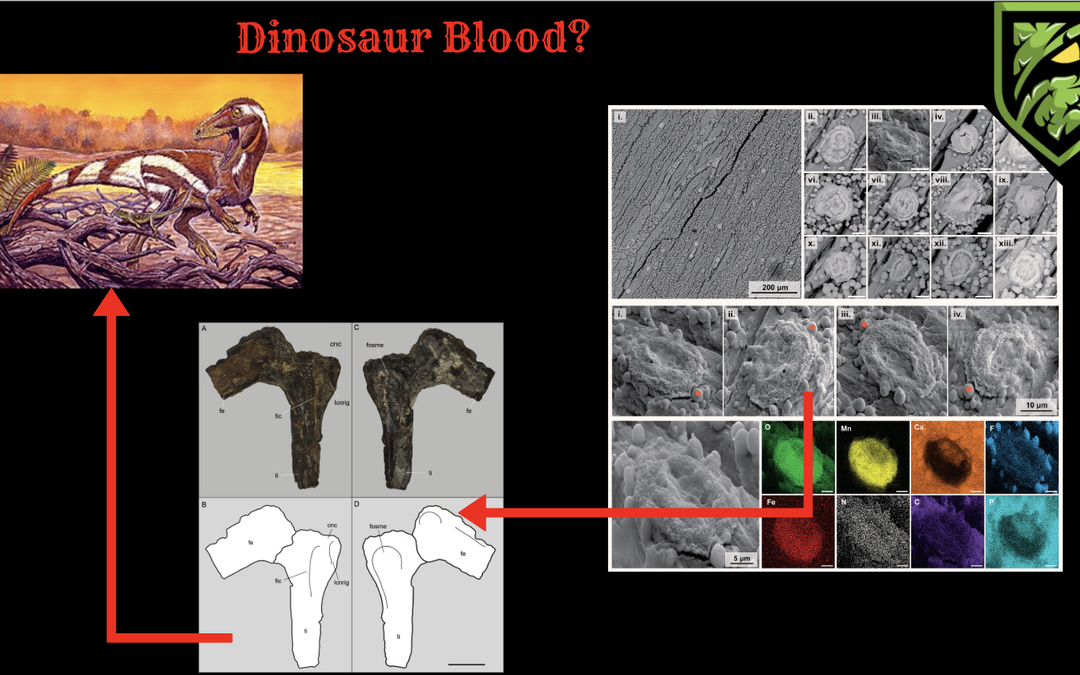
What if scientists discovered evidence of dinosaur blood preserved for more than 100 million years?
Not just fossilized bones or impressions of skin, but microscopic structures resembling red blood cells, alongside chemical evidence of molecules associated with blood!
In this episode, we investigate an extraordinary discovery involving Aratasaurus museunacionali, a theropod dinosaur from Early Cretaceous Brazil that lived approximately 115 million years ago.
Researchers examining its fossilized bones identified microscopic structures interpreted as mineralized red blood cells, alongside chemical signatures associated with heme, a component of hemoglobin.
But how could anything associated with blood survive for 115 million years?
We’ll explore the science behind the discovery, the techniques researchers used to examine the fossil, the role of minerals in preservation, and what this could mean for the future of molecular paleontology.
We’ll also tackle the big questions:
🩸 Have scientists actually discovered dinosaur blood?
🧬 Does this mean dinosaur DNA could survive?
🔬 How can microscopic biological structures and chemical signatures survive for millions of years?
And most importantly, what other secrets could still be hiding inside dinosaur fossils?
This isn’t Jurassic Park, and scientists haven’t recovered liquid dinosaur blood or intact DNA. But the evidence reported in this study is an exciting development in our understanding of fossil preservation.
📚 SCIENTIFIC PAPERS & FURTHER READING
-
THE 115-MILLION-YEAR-OLD DINOSAUR BLOOD DISCOVERY
Grice, K., Isaji, Y., Wiemann, J., et al. (2026).
“Heme signatures in mineralized red blood cells within vascular canals of a 115-million-year-old dinosaur bone.”
Proceedings of the National Academy of Sciences, 123(46), e2614248123.
🔗 Read the scientific paper:
https://doi.org/10.1073/pnas.2614248123
-
THE ORIGINAL DESCRIPTION OF ARATASAURUS
Sayão, J. M., Saraiva, A. Á. F., Brum, A. S., et al. (2020).
“The first theropod dinosaur (Coelurosauria, Theropoda) from the base of the Romualdo Formation (Albian), Araripe Basin, Northeast Brazil.”
Scientific Reports, 10, 10892.
🔗 Read the scientific paper:
https://doi.org/10.1038/s41598-020-67822-9
-
EARLIER RESEARCH ON HEME IN DINOSAUR BONES
Schweitzer, M. H., Marshall, M., Carron, K., et al. (1997).
“Heme compounds in dinosaur trabecular bone.”
Proceedings of the National Academy of Sciences, 94(12), 6291–6296.
🔗 Read the scientific paper:
https://doi.org/10.1073/pnas.94.12.6291
-
SOFT-TISSUE AND CELLULAR PRESERVATION IN TYRANNOSAURUS REX
Schweitzer, M. H., Wittmeyer, J. L., Horner, J. R., & Toporski, J. K. (2005).
“Soft-tissue vessels and cellular preservation in Tyrannosaurus rex.”
Science, 307(5717), 1952–1955.
🔗 Read the scientific paper:
https://doi.org/10.1126/science.1108397
-
BLOOD-CELL-LIKE STRUCTURES IN AN ANCIENT MARINE REPTILE
Plet, C., Grice, K., Pagès, A., et al. (2017).
“Palaeobiology of red and white blood cell-like structures, collagen and cholesterol in an ichthyosaur bone.”
Scientific Reports, 7, 13776.
🔗 Read the scientific paper:
https://doi.org/10.1038/s41598-017-13873-4
🌎 SUPPORT PREHISTORIC LIFE
Website: https://prehistoriclifepodcast.com/
Subscribe for more paleontology, dinosaur discoveries, fossil research, and the latest developments in prehistoric science!
👍 Like, comment, and subscribe to help support the show.
LET’S GET PREHISTORIC!