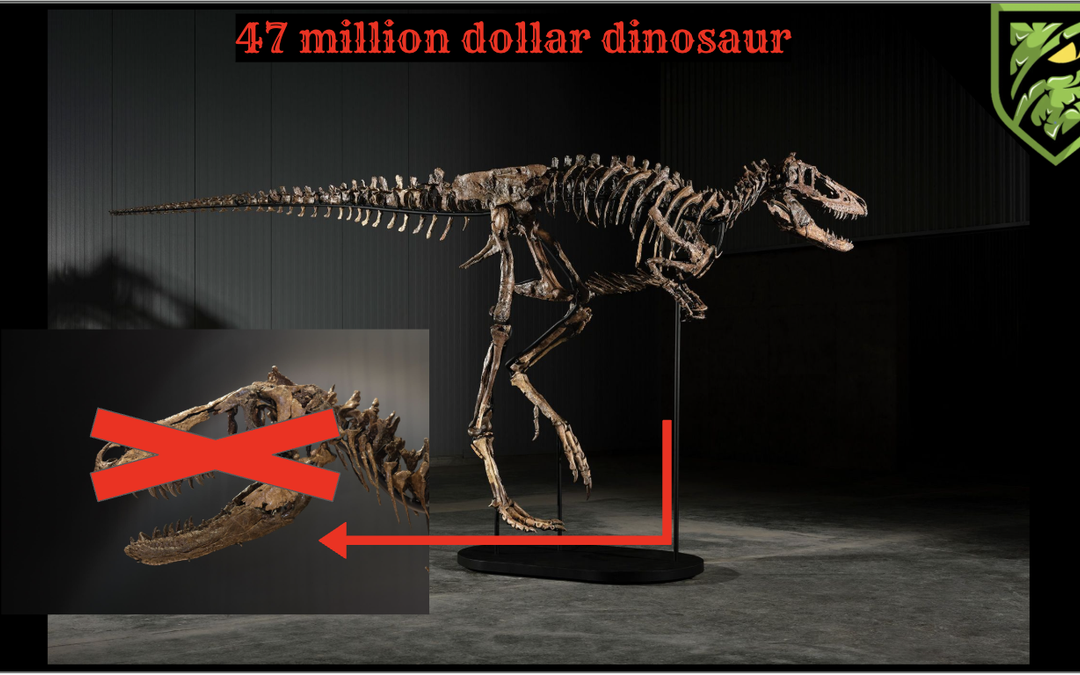
💀 A dinosaur skeleton sells for $47.3 million. But this isn’t a Tyrannosaurus rex. It’s Jodi, a remarkably complete fossil attributed to one of the most controversial dinosaurs in paleontology: Nanotyrannus!
For decades, paleontologists debated whether Nanotyrannus was a genuine dinosaur or simply a juvenile Tyrannosaurus rex. Smaller tyrannosaur fossils had many of the same features as young T. rex, leaving researchers with a difficult question: were these animals actually different species?
In 2025 and 2026, two major scientific studies brought new evidence into the debate. One examined an exceptionally preserved skeleton from the Hell Creek Formation, while another investigated the microscopic structure of the original Nanotyrannus skull’s hyoid bone.
Together, these studies provided powerful evidence that Nanotyrannus was a distinct animal that lived alongside Tyrannosaurus rex near the end of the Cretaceous.
Then came Jodi.
Discovered in Montana in 2019, this approximately 70%-complete skeleton went up for auction at Sotheby’s on October 27, 2026. The final price? Approximately $47.3 million, making it the second-most expensive dinosaur fossil ever sold at auction at the time.
But Jodi’s sale raises a much bigger question: should scientifically important fossils be owned by private collectors, or should they be preserved in public museums where researchers and future generations can study them?
In this episode, we’ll explore the history of Nanotyrannus, the fossils that changed the debate, the latest scientific evidence, Jodi’s extraordinary auction, and the ongoing discussion about who should own the world’s most important fossils.
🦖 Was Nanotyrannus really a separate dinosaur? Let’s investigate!
📚 SCIENTIFIC PAPERS & FURTHER READING
-
“Nanotyrannus and Tyrannosaurus coexisted at the close of the Cretaceous”
Authors: Lindsay E. Zanno and James G. Napoli (2025)
Journal: Nature, 648, 357–367
This study examined the exceptionally preserved specimen NCSM 40000 and concluded that Nanotyrannus was distinct from Tyrannosaurus. The authors also proposed a second species, Nanotyrannus lethaeus.
🔗 https://doi.org/10.1038/s41586-025-09801-6 -
“A diminutive tyrannosaur lived alongside Tyrannosaurus rex”
Authors: Christopher T. Griffin, Jeb Bugos, Ashley W. Poust, Zachary S. Morris, Riley S. Sombathy, Michael D. D’Emic, Patrick M. O’Connor, Holger Petermann, Matteo Fabbri, and Caitlin Colleary (2026)
Journal: Science, 391(6782), 300–305
This research examined the microscopic structure of the original Nanotyrannus holotype’s ceratobranchial, a bone in the throat region. The authors concluded that the animal was nearing or had reached skeletal maturity, providing another line of evidence that Nanotyrannus was distinct from T. rex.
🔗 https://doi.org/10.1126/science.adx8706
🎥 JODI AT SOTHEBY’S
Jodi’s auction and sale:
https://www.sothebys.com/en/videos/jodi-the-nanotyrannus-becomes-second-most-valuable-dinosaur-ever-sold-bidding-battles
💬 What do you think? Should scientifically important fossils like Jodi be placed in public museum collections, or should private collectors have the right to purchase and own them?
And are you convinced that Nanotyrannus was a distinct dinosaur?
Let me know in the comments!
🌎 Subscribe to Prehistoric Life for more paleontology, dinosaur discoveries, and prehistoric science.
Keep it prehistoric life!