
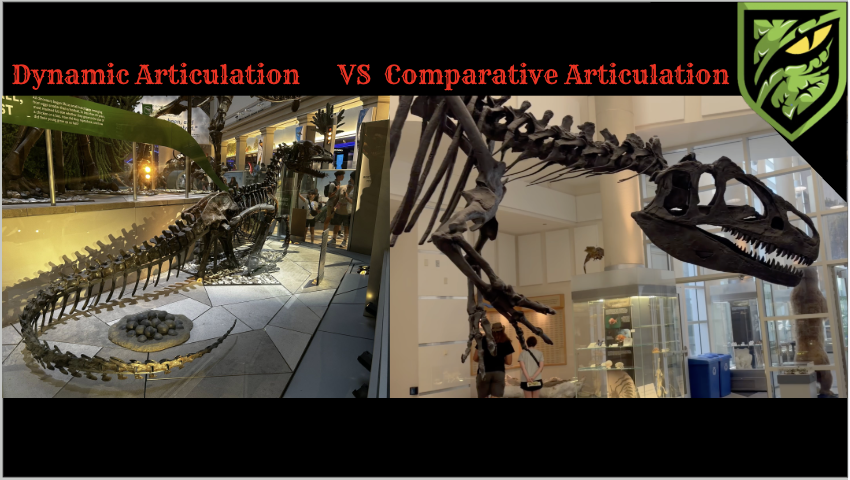
🦴 Comparative Articulation
I define comparative articulation as a full specimen, or most of a specimen, articulated primarily to display its biological structure—essentially answering the question:
“What are they supposed to look like?”
The goal is to clearly communicate the animal’s anatomy and allow visitors to understand how the bones fit together.
🏃 Dynamic Articulation
Dynamic articulation takes a different approach. I define it as reconstructing the entire skeleton in a dynamic, lifelike posture designed to demonstrate natural biomechanics—essentially showing:
“What did they do?”
Rather than simply presenting the skeleton, the display attempts to capture an action or behavior, giving visitors a sense of how the animal may have moved and interacted with its environment.
In this episode, I’ll discuss the differences between these approaches, the strengths and weaknesses of each, and why I think both have an important place in modern natural history museums.
Should a dinosaur skeleton stand in a scientifically clear anatomical pose?
Or should it be running, fighting, feeding, hunting, or performing some other behavior?
And ultimately, can a museum display do both?
🎙️ Prehistoric Life Podcast
Exploring the past. Discovering the science. Bringing prehistoric life to you.
#Paleontology #Dinosaurs #Museum #NaturalHistoryMuseum #DinosaurMuseum #Fossils #DinosaurSkeleton #PaleontologyPodcast #PrehistoricLife #PrehistoricLifePodcast #MuseumDisplays #DinosaurDisplay #DinosaurArticulation #MuseumExhibits #Dinosaurs